Where the heat actually goes
The single most useful fact in four-season pool design is this: roughly 70 percent of a pool's energy is lost off the surface of the water. Not through the walls, not through the floor, off the top. Evaporation carries heat away continuously, and wind and cold air accelerate it.
That number reframes the whole problem. Heating a pool in a Washington winter is not primarily a question of how much heat you can add, it is a question of how little you let escape. An owner who understands that tends to make very different equipment decisions.
The practical consequence is that the cover is not an accessory. It is the most consequential piece of equipment on a four-season pool, and every other decision is made easier by having one.
Integrated cover systems
Integrated cover systems are available and recommended on the pools we build for year-round use. Integrated means the cover mechanism is designed into the structure from the beginning, housed in a recessed vault or beneath the coping rather than sitting on the deck as an afterthought.
Designing it in matters for two reasons. Aesthetically, an integrated cover disappears when open, which preserves the clean water plane that is the whole point of a tile pool. Practically, a cover that is effortless to deploy gets used, and a cover that is awkward does not. The best cover in the world provides no benefit sitting in its housing.
Beyond heat, covers keep debris out, which matters in wind-driven areas such as the Kittitas Valley and the Tri-Cities, and they dramatically reduce water loss through evaporation across a long hot Eastern Washington summer.
Air-source heat pumps
Modern air-source heat pumps have changed what is realistic in a cold climate. Rather than burning fuel to create heat, they move heat from the outside air into the water, and current units operate down to minus 4 degrees Fahrenheit. That covers the overwhelming majority of Washington winter conditions, including Spokane.
Because a heat pump moves heat rather than generating it, it is most effective when it is maintaining a temperature rather than recovering from a large drop. That is why the cover and the heat pump are a pair rather than alternatives. Together they hold a stable water temperature through cold nights, which is exactly the condition that makes winter use pleasant instead of theoretical.
Shell insulation supports the same goal. Two inch foam on the shell reduces heat loss into cold ground, which is a meaningful advantage on properties where winter soil temperatures stay low for months.
Spools and spas: the elements used in January
Honesty about behavior matters here. Even with excellent equipment, most owners do not swim laps in a large pool in midwinter. What they do use, constantly, is a spa or a spool.
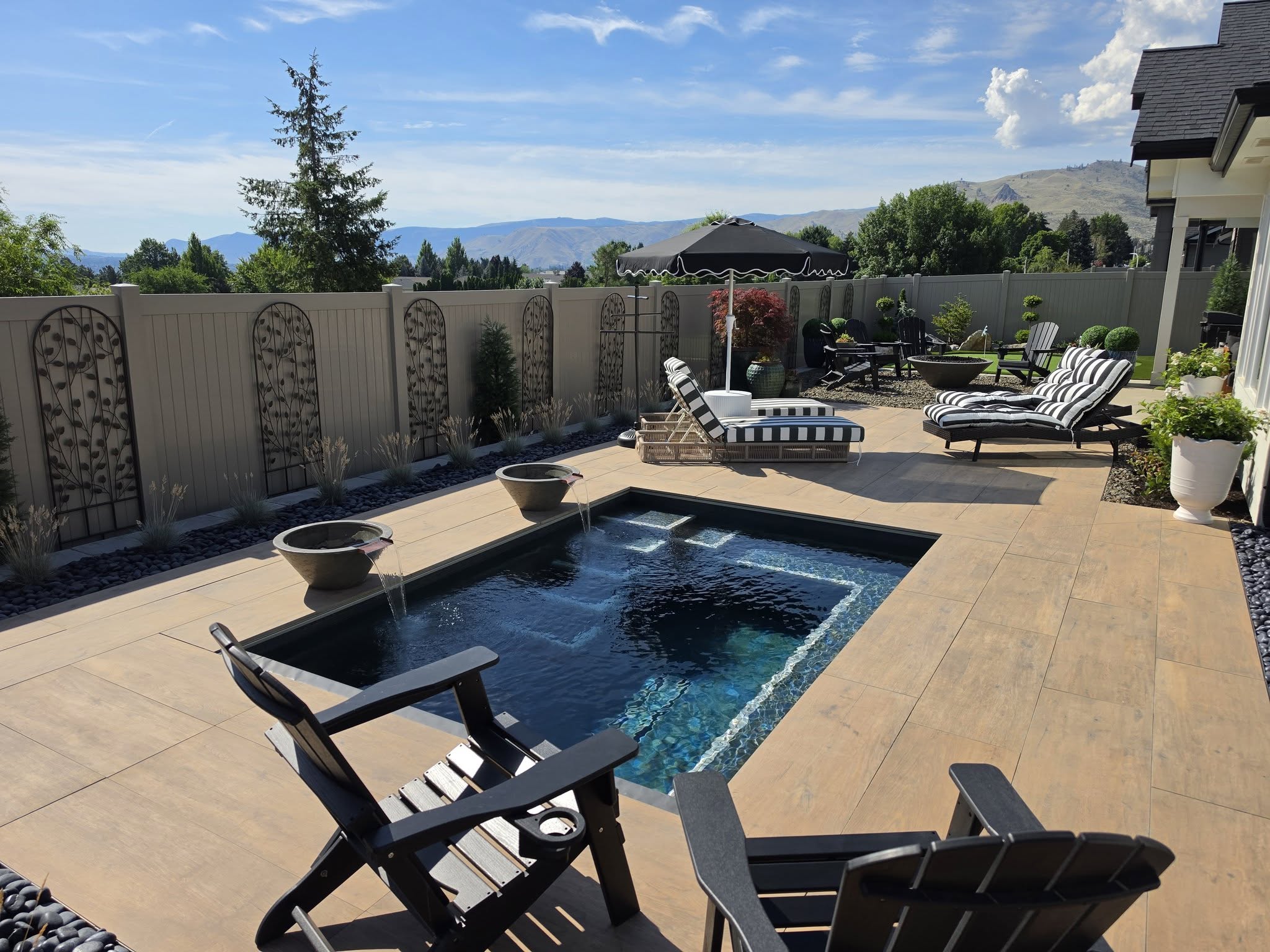
A spool is a small pool engineered for exercise, therapy, cooling, soaking, and year-round use. It holds a fraction of the water of a full pool, which means it heats quickly and holds temperature easily, and it fits properties where a full pool would consume the entire yard. With jets or a swim current it serves as exercise space, and at temperature it serves as a spa.
On larger properties we frequently build a main pool paired with a raised tile spa that spills into it. The pool carries the summer, the spa carries the winter, and the spillway ties them together visually year-round. That pairing is the most reliable way we know to make a Washington property genuinely four-season.
Automation and remote control
Full automation controls pumps, valves, heaters, lighting, and pH and chlorine management, and it can be operated from a phone. For a year-round pool this moves from convenience to necessity.
In winter the useful pattern is simple: the pool sits covered and dormant at a low maintenance temperature, and the owner brings the spa or spool up before they want it. On a vacation property in Chelan or Leavenworth, that means starting the heat from home hours before the drive over the pass.
Automation also protects the system. Freeze protection logic circulates water when temperatures approach the threshold, and remote chemistry monitoring flags a problem in a week when nobody is on the property, which is precisely when problems become expensive to ignore.
What year-round design changes about the build
Designing for winter use changes real decisions early. Plumbing is routed and detailed for freeze protection. The equipment pad is sized and placed for a heat pump, with the clearances one needs for airflow, and located where its operating noise does not intrude on the living space.
The cover vault is designed into the structure rather than retrofitted. Shell insulation is decided before concrete. Deck materials are chosen to handle freeze-thaw cycling and to remain safe when wet and cold. Windbreaks and shelter are planned around the spa rather than only the pool, because that is where people will be standing in November.
Finish choice follows the same logic. A heated, covered, continuously used pool carries a heavier chemical and thermal load than a pool that sits idle for half the year. Porcelain tile is indifferent to that load, where a plaster surface ages faster under it. Four-season use is one of the strongest practical arguments for an all-tile interior.