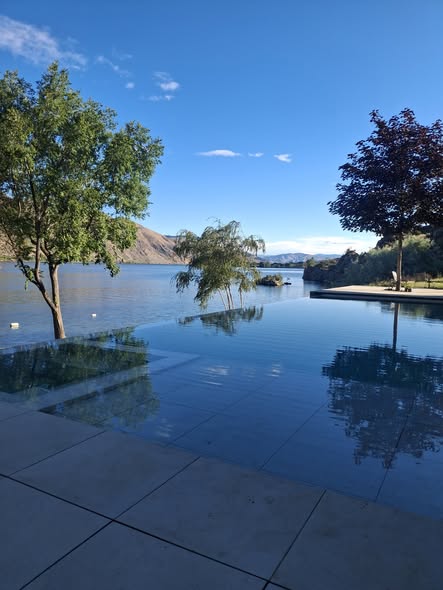
What is actually happening
A vanishing edge, also called an infinity edge or negative edge, is a pool wall built lower than the water level, with the top of that wall finished as a level weir. Water flows continuously over the weir, falls into a hidden catch basin below, and is pumped back into the pool. The visible surface therefore has no coping and no visible boundary, so from the right viewing angle it merges with whatever lies beyond it.
That last clause is the whole design problem. The effect is angle dependent. It works from the vantage point it was designed for, generally the house, a terrace, or an arrival approach, and it works because the weir elevation was set deliberately against the horizon line that is being borrowed: a lake surface, a river, a valley, a ridge.
This is why a vanishing edge cannot be added to a pool plan as a feature selection. It is a decision about where the water plane sits on the property, and it has to be made before anything else is fixed.
Which sites suit an edge
The honest answer is that many properties do not suit one, and putting an edge on the wrong site produces an expensive wall with water running down it rather than the effect anyone wanted.
What a vanishing edge needs is grade change. The ground beyond the edge has to fall away, so that the observer's eye passes over the weir without landing on the ground immediately behind it. It also needs a view worth borrowing. The edge frames whatever is beyond it, and if that is a fence line the frame simply emphasizes the fence.
In our service area, the classic candidates are bluff and bench lots above the Columbia and Snake in the Tri-Cities, hillside properties above Lake Chelan, and view lots on slopes around Wenatchee and Spokane. On flatter ground, a perimeter overflow, where water spills over all four sides into a slot drain, often delivers a similar sense of a mirror-flat water plane without depending on grade.
Where the ground falls away, the edge wall also becomes a retaining structure carrying real load, which brings geotechnical review and structural engineering to the front of the project rather than the end.
Structure and construction tolerance
The weir has to be level. Not approximately level, genuinely level along its whole length, because water finds the low point immediately and reveals any deviation as a visibly uneven sheet. Tolerances here are measured in fractions of an inch across the entire run, which is unforgiving work in concrete and tile.
Achieving that over years, rather than only on the day of construction, is a structural question. Any settlement or deflection in the edge wall shows up in the water line permanently. This is one of the clearest arguments for the way we build: ten inch shells with half inch rebar at ten inches on center each way, engineered footings, and geotechnical review on sloped ground. A light shell on a slope will move, and an edge is the element that will report it.
The edge detail itself is tile work of a high order. A porcelain weir gives a crisp, permanent line with a surface that does not degrade under constant flowing water, where plaster at a continuously wetted edge weathers faster than the rest of the pool.
The catch basin and the hydraulics
Below the edge sits the catch basin, sometimes called a surge tank or trough. It receives everything that flows over the weir and holds the water volume that the system needs in reserve. It is hidden, usually behind or beneath the edge wall or the deck, and it is the part of the design that determines whether the pool behaves well or badly.
Sizing is the critical calculation. The basin has to hold the water in transit over the edge, plus displacement from swimmers in the pool, plus a reserve so the pump never draws air, plus capacity for rain. Undersize it and the basin runs dry and the pump cavitates, or it overflows and dumps water. Oversize it without accounting for surface area and evaporation climbs.
A dedicated edge pump, separate from the main circulation pump, moves water from the basin back into the pool. Its flow rate sets the character of the edge: a low rate produces a thin, quiet, glassy film, a higher rate produces a visible sheet and audible falling water. That choice is aesthetic and should be made deliberately during design, not discovered at startup. Variable-frequency drive pumps allow the effect to be tuned and to run efficiently, and automatic water levelling keeps the basin within its working range.
One detail owners appreciate knowing in advance: the edge only runs when the edge pump runs. With automation, most owners schedule it for the hours they are outside and let the pool sit as a still mirror the rest of the time, which reduces both energy use and evaporation.
Living with a vanishing edge
Maintenance is not difficult, but it is different from a conventional pool and worth understanding before committing to one.
Evaporation is higher, because water moving as a thin sheet over a wall exposes far more surface area to the air. Expect to add water more often, which is why automatic levelling is standard on our edge builds. Wind matters too, since a strong crosswind can carry spray beyond the basin, and that is accounted for in basin sizing and edge placement on exposed sites.
The weir and the basin need periodic attention. Mineral deposits will form along a continuously wetted edge, particularly in hard water, and porcelain makes that a straightforward cleaning task rather than a permanent staining problem. The basin should be inspected and cleaned like any other part of the system, since debris that goes over the edge collects there.
None of this is onerous. It is simply the trade for the single most striking thing a pool can do on the right property. If you are considering one, the portfolio has several completed edges across Chelan, the Tri-Cities, and the Columbia Basin that show how differently the same idea resolves from site to site.